Beauty Story Clinic Gangnam — Personalized 1:1 Aesthetic Care & Anti-Aging Specialists

Medical Guide
Estefil Korea: Collagen Filler for Skin Texture and Contour Guide
Estefil in Korea is a collagen-stimulating filler for texture and contour. Learn how it works, candidacy, and what to expect at a Seoul clinic.
Schedule a ConsultationEstefil Korea: Collagen Filler for Skin Texture and Contour Guide
Medically reviewed by Dr. Bit-na Seo, Korean Board-Certified Plastic Surgeon
If you have been researching Korean skin treatments, you may have come across Estefil, a collagen-stimulating injectable that is discussed alongside better-known biostimulators and dermal fillers. Estefil is offered at Beautiful Story Clinic in Gangnam, Seoul, as one option within a broader menu of injectable treatments for facial rejuvenation. This guide explains what Estefil is, how collagen-stimulating fillers differ from conventional hyaluronic acid fillers, which patient concerns it is typically matched to, and what the treatment experience and recovery generally involve. It is written for a US audience, so it also addresses an important regulatory point up front: Estefil is a Korean product and its regulatory status differs from products approved in the United States. This article is educational and is not a self-diagnosis tool. Whether Estefil is appropriate for you can only be determined through an in-person consultation and individual facial analysis with a qualified physician.
What Estefil Is
Estefil is a collagen-stimulating injectable treatment offered for facial rejuvenation and volume restoration. Rather than simply filling wrinkles, it is intended to encourage the body's natural collagen production, which can help improve skin quality while restoring facial contours. In practical terms, this means Estefil is designed to do two things over different time frames: provide some immediate structural support where it is placed, and support progressive skin improvement as collagen develops over time.
The treatment is generally positioned for patients experiencing age-related volume loss, reduced skin elasticity, and facial folds who prefer gradual, natural-looking improvement rather than a dramatic or overfilled result. At Beautiful Story Clinic, the emphasis is on personalized treatment planning based on each patient's facial anatomy, skin condition, and aesthetic goals. The stated aim is balanced, natural facial rejuvenation instead of an overfilled appearance, with the understanding that results vary according to individual skin characteristics and how the treatment is planned.
Because Estefil is designed to stimulate collagen rather than only to add volume, it sits in a different conceptual category from a simple space-filling product. Understanding that distinction is the key to setting realistic expectations, so it is worth walking through how collagen-stimulating fillers work compared with the hyaluronic acid fillers that many US patients are already familiar with.
Regulatory Status: An Important Note for US Patients
Estefil is a Korean product. It is not approved by the US Food and Drug Administration (US-FDA). If you are researching from the United States, this is an important distinction to understand clearly: a product that is available and used in Seoul is not necessarily reviewed or approved under the US regulatory framework, and Estefil specifically is not FDA-approved. This does not describe the product's clinical use in Korea; it simply means that the US approval pathway, which governs which products may be marketed as dermal fillers in the United States, has not cleared this specific product.
For that reason, Estefil is discussed here as a treatment offered in Seoul, not as a US-available option. If you are comparing it against products you may have read about at home, remember that regulatory status differs by country, and that FDA approval or clearance is specific to the United States. The FDA maintains public information on soft tissue fillers and on aesthetic devices generally, and reviewing those resources can help you understand how the US framework categorizes these products. During a consultation, it is reasonable to ask the treating physician directly about a product's regulatory status, its composition, and how it is expected to behave in your skin so that you can make an informed decision.
Collagen-Stimulating Fillers vs Hyaluronic Acid Fillers
To understand where Estefil fits, it helps to compare two broad approaches to injectable facial rejuvenation.
Hyaluronic acid (HA) fillers are the category most people picture when they hear the word "filler." Hyaluronic acid is a substance that occurs naturally in the skin and binds water. When an HA filler is injected, it adds volume more or less immediately by occupying space and drawing in water. The visible effect appears quickly, and the result is largely a function of the gel that has been placed. Many HA products are also associated with a degree of reversibility, because in the US framework certain HA fillers can be addressed with an enzyme that breaks down hyaluronic acid. HA fillers are typically chosen when the goal is direct volume or contour in a specific area.
Collagen-stimulating fillers work through a different mechanism. Instead of relying only on the injected material to provide volume, they are designed to encourage the skin to produce more of its own collagen over time. Collagen is the structural protein that gives skin firmness and support, and its natural production tends to decline with age. A collagen-stimulating product aims to prompt a gradual, self-generated improvement in skin structure and quality. Because this response builds over weeks to months, the most meaningful changes from a collagen-stimulating approach are usually progressive rather than instantaneous, even when some immediate support is felt at the time of treatment.
Estefil is described as a collagen-stimulating injectable. Its intended value is not only in the volume placed on the day of treatment, but in the collagen response it is meant to support afterward, which is why it is often discussed in the context of skin quality, firmness, and contour rather than pure volumizing alone. This is also why patient expectations for a collagen-stimulating treatment should be framed around gradual change. If you are expecting the entire result to be visible the moment you leave the clinic, a collagen-stimulating approach may feel different from what you anticipated, and that is worth discussing openly during consultation.
It is important not to overstate the contrast. Both categories are injectables, both are placed by a physician after assessment, and both can be part of a thoughtful rejuvenation plan. The right choice depends on the individual's concern, anatomy, and goals, which is precisely why individual assessment matters more than the category label.
Who Estefil May Suit
According to the clinical profile provided by the clinic, Estefil may be suitable for adults with facial volume loss due to aging, mild to moderate wrinkles and folds, reduced skin firmness and elasticity, and a desire for gradual, natural-looking rejuvenation. Just as important, suitable candidates are those with realistic expectations following a professional consultation.
Patients commonly consider Estefil for several overlapping reasons: to restore age-related facial volume loss, to improve facial contours, to stimulate natural collagen production, to improve skin firmness and elasticity, to reduce the appearance of facial lines and folds, and to achieve natural-looking, non-surgical facial rejuvenation. If your primary interest is refining texture and softening lines while supporting firmness, rather than adding large amounts of volume in a single sitting, that profile aligns with how Estefil is generally positioned.
Estefil is not appropriate for everyone. The treatment may not be suitable for patients with active skin infection or inflammation in the treatment area, certain medical conditions that affect healing, or anyone determined to be unsuitable after consultation and clinical assessment. As with injectable treatments generally, factors such as pregnancy or breastfeeding, autoimmune or bleeding conditions, and known allergies should be discussed with the clinic and physician, who can confirm whether treatment is advisable for your situation. This is one reason a self-directed decision is discouraged: candidacy depends on a professional evaluation that weighs your medical history alongside your aesthetic goals.
How Estefil Is Approached at Beautiful Story Clinic
A defining feature of the approach at Beautiful Story Clinic is that treatment begins with individual facial analysis by Dr. Bit-na Seo rather than a standardized package. The clinic evaluates facial anatomy, skin quality, degree of volume loss, medical history, and aesthetic concerns. Based on this assessment, an individualized plan is created to determine whether Estefil is appropriate and to identify the specific treatment areas.
The clinic describes treating the face as a multi-layered system and recommending only clinically indicated treatments. In the context of Estefil, this means the injection technique is customized to each patient's facial proportions, skin quality, degree of volume loss, and cosmetic goals, with planning aimed at balanced, natural-looking results rather than standardized correction. Dr. Seo is documented as a Korean Board-Certified Plastic Surgeon and an active member of the Korean Society of Plastic and Reconstructive Surgeons and the Korean Society for Aesthetic Plastic Surgery, and she personally leads the assessment that determines each plan.
For a US patient, the practical takeaway is that Estefil is not offered as an off-the-shelf commodity. Which product is chosen, whether Estefil is used at all, how much is placed, and where, are decisions made after an in-person evaluation. If a treatment is not clinically indicated for you, that assessment can also identify alternatives that better fit your concern.
What a Treatment Visit Generally Involves
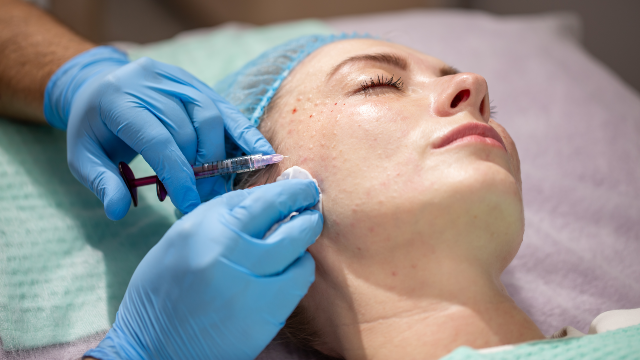
Estefil treatment is performed during an outpatient visit. The general sequence described by the clinic follows a familiar pattern for injectable treatments. First is consultation, including facial assessment and treatment planning. Next, the treatment area is cleansed and prepared. For comfort, a topical numbing cream may be applied before injections. Estefil is then injected into the planned treatment areas. Afterward, facial symmetry and correction are evaluated, and aftercare instructions are provided before the patient leaves.
For pain control, a topical anesthetic is typically used to improve comfort before injections. Most patients experience mild and tolerable discomfort during the treatment itself. There are no published fixed numbers of sessions; the number of sessions and any maintenance visits is determined individually during consultation based on facial condition and treatment goals, and no standard treatment schedule is published. Results timelines and longevity are individualized as well, and specifics for your case are best confirmed directly with the clinic rather than assumed from general marketing figures.
Results, Recovery, and What to Expect
Expected benefits described for Estefil include improved facial volume, better facial contours, increased skin firmness and elasticity, gradual collagen stimulation, a softer appearance of wrinkles and folds, and natural-looking rejuvenation. Because a portion of the intended effect depends on collagen developing over time, the treatment is generally framed around progressive improvement rather than an all-at-once transformation. Results vary from person to person according to individual skin characteristics and how the treatment is planned, and an injectable does not stop the aging process; it cannot be presented as a permanent solution or a guarantee of a particular outcome.
Recovery is generally described as involving minimal downtime, with most patients able to return to normal daily activities shortly after treatment. As with injectable procedures generally, temporary injection-site reactions can occur. Commonly reported temporary effects include redness, swelling, bruising, tenderness, or mild discomfort at the injection sites, and these generally improve naturally over the following days. Patients are advised to follow the clinic's instructions and to seek medical advice if symptoms are severe, prolonged, or unexpected. More serious or vascular complications are possible with any injectable and should be assessed by the treating physician; warning signs and specific risks are part of what a proper consultation covers.
For aftercare, the clinic's guidance is to follow post-treatment instructions, monitor treated areas for temporary reactions, attend recommended follow-up appointments, and contact the clinic if unusual symptoms occur. Because Estefil is one option among several, the plan may also address how it fits with any other treatments you are considering.
Estefil Compared With Other Options
Patients researching Estefil often want to know how it compares with other collagen-supporting or volumizing treatments, and searches such as "Estefil vs Radiesse" are common. It is fair to say that Estefil belongs to the collagen-stimulating category, meaning it is intended to work with the skin's own collagen response rather than acting purely as a volume gel. Other products in the aesthetic landscape work in different ways, ranging from hyaluronic acid fillers that add immediate volume to other biostimulatory materials, and each has its own composition, behavior, and regulatory status in a given country.
Rather than declaring one product superior, the more useful framing is which approach matches a specific concern. A patient primarily focused on refining texture and softening fine lines while supporting firmness has different needs than someone with significant, well-defined volume loss who wants immediate structural correction. This is exactly the kind of judgment that an individual facial assessment is meant to resolve. Because regulatory status and product availability differ between Korea and the United States, any comparison you read should be checked against where a product is actually approved and offered, and confirmed with the clinic for your specific situation.
Bottom Line
Estefil is a Korean collagen-stimulating injectable offered at Beautiful Story Clinic in Seoul for patients seeking gradual improvement in skin firmness, texture, and contour rather than a heavily volumized look. It works by supporting the skin's own collagen production over time while providing some immediate structural support, which sets it apart conceptually from hyaluronic acid fillers that add volume immediately. It is important for US readers to understand that Estefil is not FDA-approved and is discussed here as a treatment offered in Seoul, with regulatory status differing by country. Realistic expectations matter: results are gradual and vary between individuals, temporary injection-site effects such as redness, swelling, bruising, and tenderness can occur, and an injectable does not halt aging or guarantee an outcome. Whether Estefil is right for you depends on an in-person consultation and individual facial analysis, which at this clinic is led by Dr. Bit-na Seo, a Korean Board-Certified Plastic Surgeon.
Frequently Asked Questions
**Is Estefil FDA-approved?**No. Estefil is a Korean product and is not approved by the US Food and Drug Administration. It is offered in Seoul, and regulatory status differs by country. FDA approval and clearance are specific to the United States, so a product available in Korea is not necessarily reviewed under the US framework.
**How is Estefil different from a hyaluronic acid filler?**Hyaluronic acid fillers add volume more or less immediately by occupying space and drawing in water. Estefil is a collagen-stimulating injectable designed to encourage the skin's own collagen production over time, so a meaningful part of its intended effect is gradual rather than instant, even though some immediate structural support is provided.
**When will I see results, and how long do they last?**Because Estefil is intended to stimulate collagen, improvement is generally progressive. Results vary according to individual skin characteristics and treatment planning. The clinic determines results timelines individually, and specific longevity for your case should be confirmed directly during consultation rather than assumed.
**Is Estefil painful, and is there downtime?**A topical anesthetic is typically applied to improve comfort, and most patients report mild, tolerable discomfort during treatment. Downtime is generally minimal, with most patients returning to normal activities shortly afterward. Temporary redness, swelling, bruising, or tenderness at injection sites can occur and usually improve over the following days.
**How many sessions will I need?**There is no published standard schedule. The number of sessions and any maintenance visits is decided individually during consultation, based on your facial condition and treatment goals.
**How do I know if I am a candidate?**Candidacy is determined through an in-person consultation and individual facial analysis. The clinic evaluates facial anatomy, skin quality, degree of volume loss, medical history, and aesthetic concerns before recommending treatment. This article cannot tell you whether Estefil is right for you; only a qualified physician can, after examining you.
Disclaimer
This article is for general educational purposes only and is not medical advice or a self-diagnosis tool. It does not establish a physician-patient relationship. Estefil is a Korean product that is not FDA-approved and is discussed here as a treatment offered in Seoul; regulatory status, product availability, and approvals differ by country. Individual results vary, and injectable treatments carry risks, including common temporary injection-site effects and, less commonly, more serious complications. Candidacy, treatment planning, and any discussion of cost require an in-person consultation and individual facial analysis with a qualified physician at the clinic.
Clinical References & Related Hospital Guides
- Related Clinic Pages: About Our Clinic & Safety Standards · Clinical Centers & Specialties · 1:1 Consultation & Appointment Inquiry
- Authoritative Medical References: American Academy of Dermatology (AAD) · NCBI PubMed Clinical Literature
More Articles
Continue reading our clinical guides.

Dr. SEO BINNA Guide To Seoul Plastic Surgery Excellence
Learn why Dr SEO BINNA is the premier choice for lifting and surgery in Seoul. Discover Beautiful Story Clinic for expert care and natural results.
Learn More
Stem Cell Skin Treatment Korea 2026 Clinical Guide
Discover the definitive 2026 guide to stem cell skin treatment in Korea at Beautiful Story Clinic. Learn about IV therapy and fat grafting safety.
Learn More
Oligio RF Korea Results Cost and Professional Guide 2026
Discover the benefits of Oligio RF Korea for non surgical skin tightening. Learn about results and costs in Seoul versus the USA from Dr. SEO BINNA today.
Learn More