Beauty Story Clinic Gangnam — Personalized 1:1 Aesthetic Care & Anti-Aging Specialists

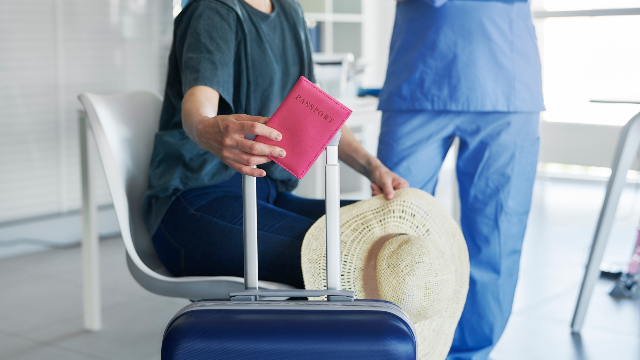
Medical Guide
Houston to Gangnam: What Texas Patients Should Know Before Traveling
A Houston-to-Gangnam travel guide for Texas patients: CDC- and State Dept-anchored entry, K-ETA, e-Arrival Card, and continuity-of-care planning.
Schedule a ConsultationHouston to Gangnam: What Texas Patients Should Know Before Traveling
Medically reviewed by Dr. Bit-na Seo, Korean Board-Certified Plastic Surgeon
If you live in Houston or elsewhere in Texas and are weighing a trip to Gangnam, Seoul, for dermatology or aesthetic skin treatment, the biggest questions are usually practical rather than clinical. How do you enter Korea? What do you file, and when? How do you get from the airport to the clinic, and how should you think about a treatment abroad differently from one at home? This guide is written for that Texas reader — someone comfortable with a long-haul trip who wants a neutral, realistic picture of the logistics before booking anything.
The aim here is to walk through entry and travel planning as a health decision, anchored to guidance from the US Centers for Disease Control and Prevention (CDC) on medical tourism and to the US Department of State's country information for Korea. Those anchors matter because when your treating clinic is on the other side of the world, follow-up, records, and timing carry more weight than they would for a treatment across town in Houston. This article is educational and is not a self-diagnosis tool. It does not quote prices, promise results, or predict flight times or fares; those belong to airlines, a clinic, and a consultation. Whether any treatment is appropriate for you can only be determined through an in-person consultation and individualized assessment with a qualified physician.
Entry Requirements for US Citizens: The Current Picture
For US passport holders, the entry framework for a short trip to Seoul is relatively straightforward as of August 2026 — but it depends on the calendar, because Korea's rules have shifted recently and are set to shift again. Three facts frame the situation: a temporary K-ETA exemption, a mandatory arrival-registration step, and a scheduled return of the K-ETA requirement. Understanding all three, and knowing where to confirm them, is the goal of this section.
Before the specifics, one habit matters more than any single detail: verification. Entry rules change, sometimes with little notice, and your situation can depend on policy updates, dates, and the purpose and length of your trip. Everything below is general information, not immigration advice. Confirm current rules with the Korean embassy or consulate, the US Department of State, and the official K-ETA site at https://www.k-eta.go.kr before you book and again close to departure.
K-ETA and the Exemption Window
K-ETA stands for Korea Electronic Travel Authorization — an online pre-travel authorization, not a visa, tied to visa-free entry. As of August 2026, US citizens are exempt from K-ETA through December 31, 2026, and may generally enter Korea visa-free for tourism or business for up to 90 days with a valid US passport. For a typical short trip for non-surgical skin treatment, this visa-free framework is what most Texas patients travel under.
Because this is a temporary exemption tied to a specific date, it is exactly the kind of rule that can be extended, changed, or allowed to lapse. Confirm its current status on the official K-ETA site before you travel rather than assuming it still applies to your dates.
The e-Arrival Card
Even with the K-ETA exemption in place, there is a separate step. Since January 1, 2026, a mandatory e-Arrival Card must be submitted online by those entering Korea without K-ETA. As of August 2026, this submission is to be made within 72 hours before arrival. It takes the place of the older paper arrival card and is completed online in the days just before your flight.
Build the e-Arrival Card into your pre-trip checklist as a distinct task, separate from booking flights and separate from any visa question. Because the timing window and portal can be adjusted, confirm the current requirement and the official submission process with the Korean consulate or official Korean government sources close to departure, and do not rely on older instructions describing a paper card.
K-ETA Returns in 2027
The exemption is time-limited. As of the current facts, from January 1, 2027, K-ETA is required again. If your trip falls in 2027 or later, expect to complete the K-ETA application before traveling, in addition to whatever arrival-registration steps apply then. Two Texas patients making nearly identical trips — one in late 2026, one in early 2027 — could face different pre-travel steps simply because of when they fly. If your dates straddle the end of 2026, be especially careful to confirm which rules apply to your specific arrival date.
When a Medical Visa May Apply
The visa-free framework is generally oriented toward shorter visits. For longer or more specialized medical stays, Korea provides a dedicated medical visa pathway — commonly referenced as the C-3-3 short-term medical visa — for patients traveling specifically for treatment, with extensions generally handled through local Korean immigration authorities and typically supported by a physician's medical certificate. Most non-surgical dermatology and aesthetic trips are short, so many Texas patients will not need this route; but if your plan involves a longer stay or sessions spread over an extended period, raise it directly with both the Korean consulate and the clinic well in advance. This guide deliberately does not state processing times, fees, or the exact forms required, because those vary by case and change over time.
Route Logistics: Houston to Gangnam
Houston is one of Texas's major international gateways, and travel to Seoul typically routes into Incheon International Airport (ICN), the primary hub serving the capital region. Whether you fly a one-stop or connecting itinerary, and which carriers and connection points are available, changes over time and by season. Those specifics — routes, schedules, fares, and flight duration — should be arranged directly with airlines and, where helpful, a travel agent. This guide does not quote flight times or prices, because they are not fixed and vary by booking; treat them as questions for the carriers, not this article.
From Incheon, Gangnam-gu sits on the south side of Seoul, across the Han River from the city center. Getting from the airport to the Gangnam district is a well-established route with several public and private options, but the right choice depends on your arrival time, luggage, and how you are feeling after a long flight. Rather than assume a specific transfer, ask Beautiful Story Clinic's international-patient support what they recommend for reaching the clinic's location at 5F, KM Gangnam Building, 562 Gangnam-daero, Gangnam-gu, and confirm any arrangements before you arrive. The clinic maintains an English-language website and documented international-patient support, which can make coordinating your arrival smoother.
Plan the on-the-ground logistics the way you would any long trip: know your route from the airport, have your accommodation and clinic address written down, and give yourself a realistic buffer after landing before any appointment. Jet lag between Texas and Korea is significant given the time difference, so building recovery time into your first day is sensible rather than scheduling treatment immediately after a long flight.
Planning the Trip as a Health Decision
This is the part that changes most when your clinic is in Gangnam and your home is in Houston, and it is where CDC medical-tourism guidance is the right anchor. The CDC frames medical travel as a health decision with real considerations, not simply a way to access a treatment. Adapted to non-surgical dermatology and aesthetic care, the core issues are continuity, risk, records, and timing.
- Continuity of care and follow-up. Many non-surgical treatments are not one-and-done. Energy-based treatments and biostimulator injectables often work gradually and may involve a course of sessions, and any procedure can raise a delayed question. Plan in advance for how follow-up and aftercare will be handled once you are back in Texas, and know who to contact, and how, if a question arises weeks later.
- Risk and complications. Every procedure carries some risk. Even minimally invasive treatments can cause temporary redness, swelling, or bruising, and less common complications are possible. Distance adds logistical layers to managing anything that appears after you have flown home.
- Records and communication. Keep copies of your medical records and know exactly what was done — which specific devices or products were used, and at what settings — so a clinician in Houston can understand your care if needed. Clear documentation is what makes continuity possible across borders.
- Timing around travel. Some treatments have short recovery windows or activity restrictions, and long-haul flights interact with recovery. Build a sensible cushion into your schedule rather than flying home the morning after a treatment; how much time to allow depends on your specific plan, so confirm it with the clinic.
None of this is a reason not to seek care abroad — many patients travel and are satisfied. It is a reason to plan deliberately. For a Texas patient, the single most valuable step is to think through follow-up and continuity of care before booking, not after landing back at the airport.
The Clinic and Its Foreign-Patient Status
For US patients, a Korea-side fact often comes up: some clinics are registered to attract and treat foreign patients. Beautiful Story Clinic is a Registered Medical Institution for Attracting Foreign Patients, certified by the Korean Ministry of Health and Welfare (MOHW). Read this correctly. It is a Korean government registration authorizing the clinic to treat international patients under Korean law. It is not US or international hospital accreditation such as JCI, it is not equivalent to US regulatory approval, and it is not a guarantee of any particular outcome. It is context about authorization under Korean law — useful to know, but nothing more than that.
On the care side, the documented model is physician-led. Treatment is personally planned and performed by Dr. Bit-na Seo, a Korean Board-Certified Plastic Surgery Specialist, in a one-patient-per-hour, reservation-based setting, with an individual facial analysis before any device or combination is chosen rather than a pre-packaged protocol. Korean board certification is its own system, distinct from US board certification; the two are separate, and one is not a substitute for the other. On immigration, the clinic can support you with clinical documentation but is not an immigration authority — decisions about K-ETA, the e-Arrival Card, and any visa rest with the Korean government.
Where Cost and Flight Details Fit
You may have arrived expecting a price comparison or a rundown of flight times and fares. This guide gives neither, and that is deliberate. Costs depend on the specific plan — which devices or products, how many sessions, which areas, and how parameters are tailored to you — and can only be defined at a consultation; comparing headline numbers between cities without knowing what is included tends to mislead. Flights, transfers, and scheduling are yours to arrange with airlines and, where relevant, the clinic. If cost or logistics is part of your decision, get plan-specific and trip-specific answers directly from the clinic and the carriers, and weigh them alongside the continuity-of-care considerations above rather than in isolation.
Bottom Line
For a Houston or Texas patient, a trip to Gangnam is best approached as a logistics-and-health-planning exercise, not a leap into the unknown. As of August 2026, US citizens are exempt from K-ETA through December 31, 2026, and may generally enter visa-free for tourism or business for up to 90 days with a valid US passport; a mandatory e-Arrival Card must be submitted online — currently within 72 hours before arrival — by those entering without K-ETA; and from January 1, 2027, K-ETA is required again. Longer or specialized stays may use a C-3-3 medical visa, with extensions through Korean immigration and a physician's medical certificate. Every one of these points can change, so confirm current rules with the Korean embassy or consulate and the official K-ETA site at https://www.k-eta.go.kr before you travel. Route your flights and airport transfer through airlines and the clinic, and let CDC medical-tourism guidance organize your follow-up, records, risk management, and timing. Beautiful Story Clinic offers a physician-led model and is MOHW-registered to treat foreign patients — context that should inform, not decide, your choice. Results vary, this is not a self-diagnosis tool, and an in-person consultation determines what is right for you.
Frequently Asked Questions
**Do Texas patients need a K-ETA to visit Seoul right now?**As of August 2026, US citizens are exempt from K-ETA through December 31, 2026, and may generally enter visa-free for tourism or business for up to 90 days with a valid US passport. From January 1, 2027, K-ETA is stated to be required again. Because this is time-limited and subject to change, confirm the current rule for your arrival date on the official K-ETA site at https://www.k-eta.go.kr before you travel.
**What do I need to file before flying from Houston?**If you enter without K-ETA during the exemption window, you generally must submit a mandatory e-Arrival Card online — currently within 72 hours before arrival. Also check that your US passport has sufficient validity, following US State Department guidance. Confirm the current e-Arrival Card requirement, timing, and official portal close to departure.
**How do I get from Incheon Airport to Gangnam?**Seoul is served primarily by Incheon International Airport, and Gangnam-gu sits on the south side of the city. Several public and private transfer options exist, but the right choice depends on your arrival time and luggage. Ask Beautiful Story Clinic's international-patient support for guidance and confirm any arrangement before you arrive. This guide does not quote flight times or fares — arrange those with airlines.
**Do I need a medical visa for treatment in Seoul?**Many Texas patients making short trips for non-surgical skin treatment travel under the visa-free framework and do not need a medical visa. For longer or more specialized stays, a C-3-3 medical visa may apply, with extensions through local Korean immigration and a physician's medical certificate. Ask the Korean consulate and the clinic about your specific situation.
**What should I plan for as a health decision?**Follow CDC medical-tourism guidance: plan for continuity of care and follow-up once you are back in Texas, understand the risks and how complications would be handled after you travel, keep copies of your medical records including which specific devices or products were used, and consider treatment timing relative to your long-haul flights. Planning follow-up before you go is the most valuable step.
This article is for general education only and is general information rather than immigration or legal advice. It is not a self-diagnosis tool or a substitute for professional medical advice; whether any treatment is appropriate for you can only be determined through an in-person consultation and individualized assessment with a qualified physician such as Dr. Bit-na Seo. Entry requirements, K-ETA rules, the e-Arrival Card process, and visa categories change over time and by individual circumstances; confirm current requirements with the Korean embassy or consulate, the US Department of State, and the official K-ETA site before you travel. Results vary between individuals, and no outcome is guaranteed.
Clinical References & Related Hospital Guides
- Related Clinic Pages: About Our Clinic & Safety Standards · Clinical Centers & Specialties · 1:1 Consultation & Appointment Inquiry
More Articles
Continue reading our clinical guides.

Dr. SEO BINNA Guide To Seoul Plastic Surgery Excellence
Learn why Dr SEO BINNA is the premier choice for lifting and surgery in Seoul. Discover Beautiful Story Clinic for expert care and natural results.
Learn More
Stem Cell Skin Treatment Korea 2026 Clinical Guide
Discover the definitive 2026 guide to stem cell skin treatment in Korea at Beautiful Story Clinic. Learn about IV therapy and fat grafting safety.
Learn More
Oligio RF Korea Results Cost and Professional Guide 2026
Discover the benefits of Oligio RF Korea for non surgical skin tightening. Learn about results and costs in Seoul versus the USA from Dr. SEO BINNA today.
Learn More